
Steroid_Kit
Steroid MCP›Server Catalog
Server Catalog
The catalog snapshot contains 241 registry entries and 3,188 tool definitions. Twelve entries have no tool definitions; 229 generated AP pieces cover the tool-bearing entries. Listing, search indexing, generated blocks and tested runtime availability are distinct.
Browsing the Catalog
Log in at steroidkit.com/catalog. There is no steroid catalog search terminal command. You do not need to browse the catalog before using a server — natural-language queries to search_tools are usually sufficient. The catalog is useful for discovering what is available, understanding auth requirements before a session, and verifying tool names.
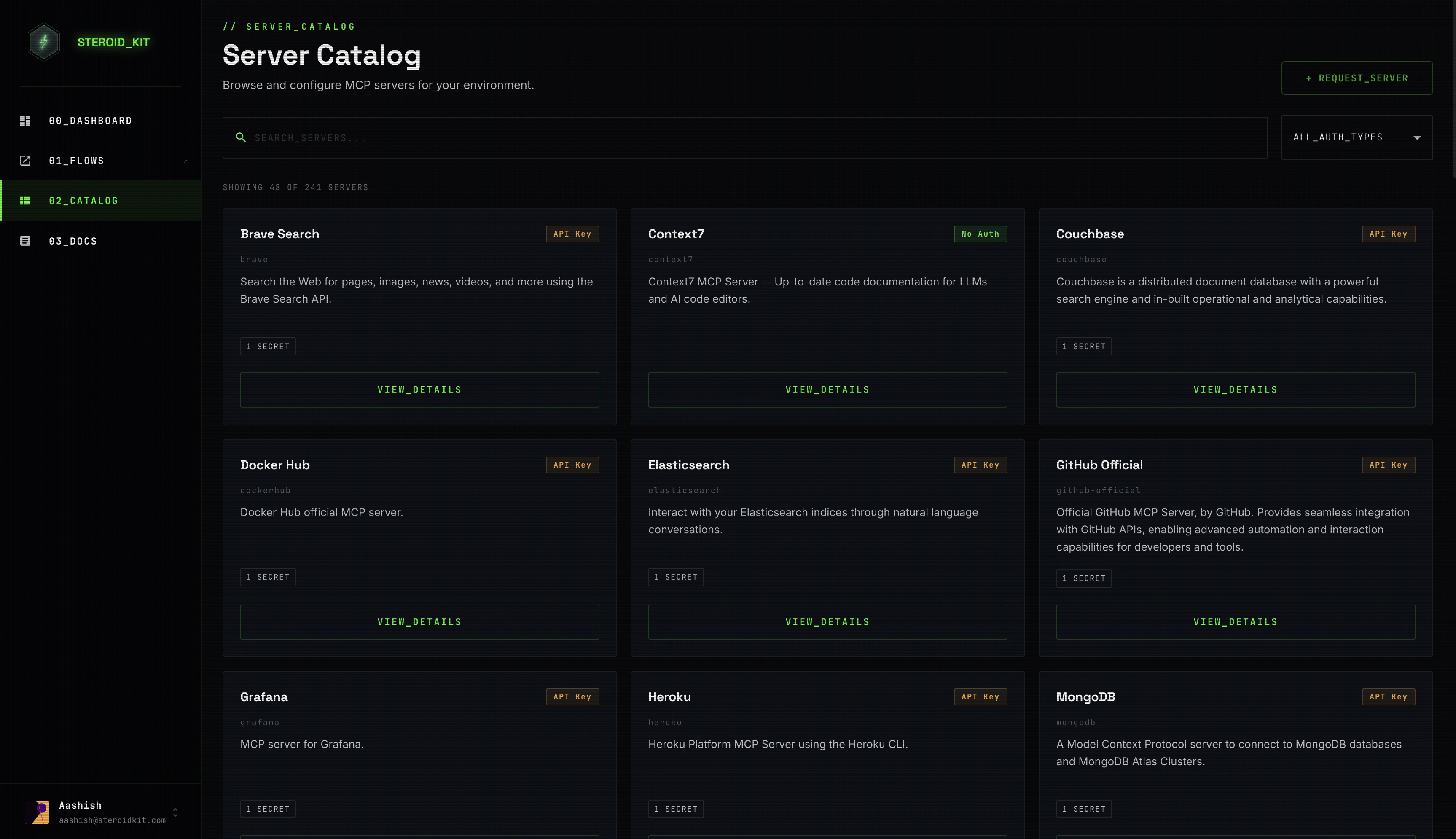
- Each catalog entry shows the server identifier, a short description, and the total number of tools it exposes
- Search, authentication filtering and pagination help narrow the registry.
- Server details show setup/configuration and tool guidance; this is not an in-browser tool-execution session.
- Use the server-request workflow for a missing integration. Catalog counts are a checkout snapshot, not a live availability SLA.
Server Categories
| Category | Example catalog key |
|---|---|
| Communication | slack |
| Developer tools | github-official |
| Databases | postgres |
| Web search | brave |
| Knowledge/productivity | notion |
Auth Types
The current web classification is 84 none, 157 API-key and zero OAuth entries. Inspect server metadata for exact secrets and configuration; a none-classified server can still need configuration. AP's upstream OAuth integrations are a different surface from Steroid gateway onboarding.
No secret declared (84 entries)
No declared secret does not mean no setup: server configuration, backend availability and required tool arguments still matter. Do not infer that a public search service never needs an API key.
API-key/secret setup (157 entries)
The most common auth type. The user provides a long-lived API key once; Steroid stores it encrypted in the encrypted local store and sends needed credentials to execution services. If a key is missing when run_toolis called, Steroid pauses execution and renders an elicitation prompt in the IDE, asking the user to paste the key. Subsequent calls reuse the stored credential automatically.
Popular Servers
github-official
Tools: 40 | Secret: github.personal_access_token
The official GitHub MCP server covers the full issue, pull request, and repository management surface. Commonly used for automated issue triage, PR review workflows, and release note generation. Example: issue_write requires method, owner and repo. Set method to create for a new issue; use permissions appropriate to the target repository and operation.
brave
Tools: 6 | Secret: brave.api_key
Brave Search provides independent web, news, and local search without Google or Bing dependency. Frequently used in research agents and fact-checking pipelines. Example: brave_web_search requires query.
slack
Tools: 8 | Secret: slack.bot_token
The Slack server handles messaging, channel management, and user lookups. It is one of the most-used servers in Steroid — commonly triggered by workflow automations that send status updates or alerts. Example: slack_post_message requires channel_idand text, not a channel-name field. Server config includes required slack.team_id.
notion
Tools: 19 | Secret: notion.internal_integration_token
Full Notion database and page management. Used for knowledge base updates, meeting note ingestion, and project tracking automations. Example: API-post-page requires parent and properties.
postgres
Tools: 1 | Secret: postgres.url
The catalog tool is query, described as a read-only SQL query. Supply sql for the query; the current metadata marks that field optional. The connection URL is a secret, not a separate password/config.connection_string contract.
TIP
Use exact returned identifiers and current server metadata. Registry changes must pass through ingestion/indexing and any required piece regeneration; catalog presence alone is not proof that a tool is executable or that every entry has a block.